Inland Empire, San Diego County and Phoenix Metro
Floor Care
Burnishing, scrub and recoat, stripping and finishing on vinyl, linoleum, grout, tile and stone, done after hours by specialists who have passed floor care training.
Chapter 01
A floor fails by degrees, and usually from the wrong product
Floors rarely give out in a single day. They wear through a protective finish nobody renewed, or they take a cleaner that was wrong for the surface, or they pass from crew to crew with each one doing something a little different. Floor damage is often caused by a lack of knowledge about cleaning agents, and what suits vinyl is not what suits stone or grout.
In a hospital corridor, a school hallway or a lobby, that damage shows first along the lanes people walk most. A floor that has lost its protection keeps getting mopped, keeps looking tired, and ends up being replaced earlier than it should have been. Regular care from one company that understands the surface is how a building avoids paying for new floors ahead of schedule.
The same goes for emergencies. When a spill or a leak threatens a floor, the instinct is to grab whatever is nearby and fix it. The better move is to put the mop down and call, because a wrong guess with a cleaning agent can add damage the spill never caused.
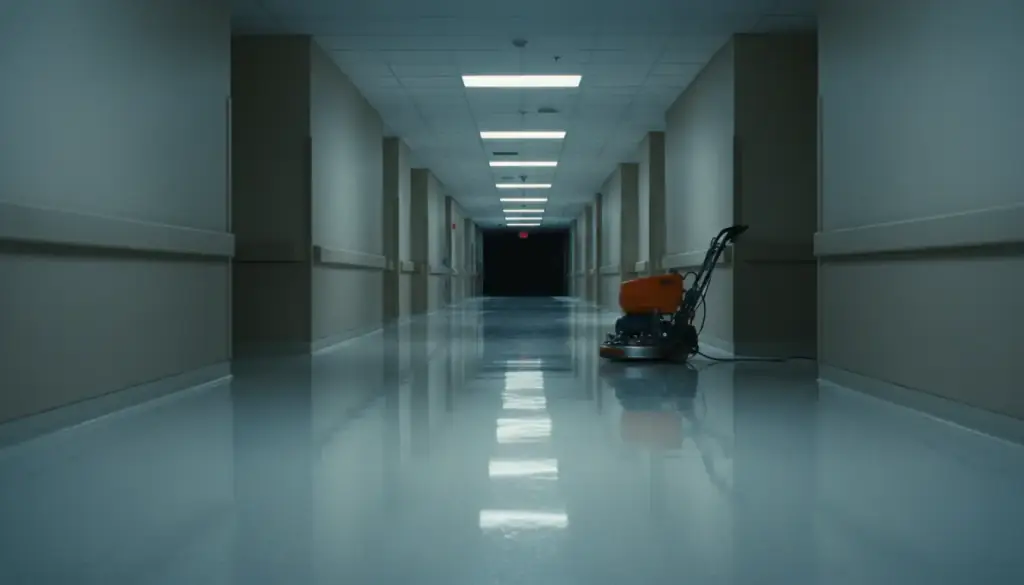
Refinished vinyl floor in a long hospital corridor with a burnisher parked at the far end
A floor inventory first, then the program
Every floor care program starts with a list: each type of floor in the building and the condition it is in. Resilient flooring such as vinyl and linoleum, grout and tile, and stone all take different treatment, and the list is what makes a program fit the building instead of a template.
The work itself covers daily maintenance, burnishing, scrub and recoating, and stripping and finishing. A scrub and recoat cleans the soil off and renews the protective coat, burnishing brings that coat back up, and stripping takes off a finish that is past saving before a new one goes down. The crew uses techniques that cut out unnecessary steps and automated equipment that saves time.
Every floor care specialist must pass floor care training before touching a floor. The efficiencies and quality assurance manager oversees that training, so technicians learn the techniques and the chemistry behind the cleaning products. Visits run from two to five hours depending on the work and the size of the space, and they are done after hours so the building keeps running by day.
Chapter 03
Quarterly or twice a year, and what to do in between
How often a floor needs attention depends on the type of floor, its approximate age and how much traffic the building sees. Most facilities land on semi-annual or quarterly floor care, with larger buildings leaning toward quarterly. If a full program is not what you want, individual floor care visits can be scheduled.
Between visits, watch the traffic lanes, the entries and any area where the finish has started to look dull or worn, and tell the support team early. An early note about a worn patch gives the crew a chance to adjust the program before the whole floor needs more.
Daily maintenance covers the days in between, and the floor care schedule covers the deep work. If something unexpected happens, the support team works with your franchise owner to resolve the issue within 24 hours.
Every OctoClean floor care specialist passes floor care training first, and franchise owners carry general liability, workers' compensation and a $25,000 janitorial bond.
Corridors, waiting rooms and hallways
Floors where the traffic never stops
Specialty floor and carpet care is part of what OctoClean provides across the 27 Loma Linda University Health facilities it has supported since 2016. Floors in clinics and dialysis centers are covered on the healthcare industry page, and school hallways on the education page.