Electrostatic Disinfection: What It Covers and What It Does Not Replace
The method is fast and thorough, and it only delivers when it sits on top of a solid daily cleaning routine.
October 27, 2026 · 4 min read
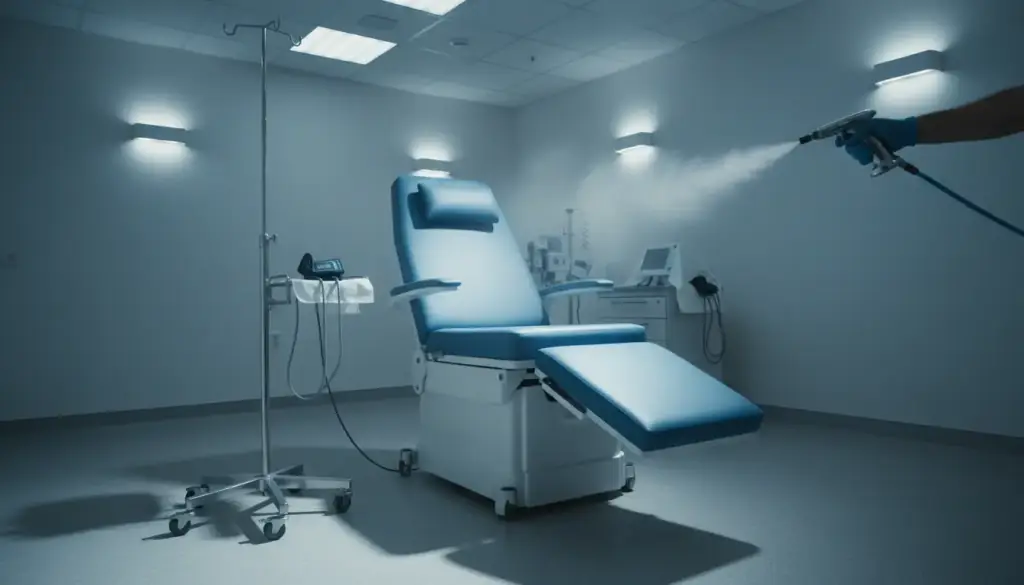
Electrostatic disinfection gets described in a lot of ways, and some of them promise more than any method can deliver. For a facility manager or practice manager, the useful questions are narrower. What does the service do? What does it leave to the rest of your cleaning program? And how do you schedule it without disrupting the people in the building?
How the sprayer works
An electrostatic sprayer gives disinfectant droplets an electrical charge. Charged droplets are attracted to surfaces and cling to them, so the solution wraps around an object instead of landing only on the side facing the nozzle. That is the basis for the 360-degree coverage OctoClean describes: the underside of a chair seat, the edge of a counter, the back of a handrail.
The practical advantages are coverage and speed. A technician moving through a room with a sprayer can treat a lot of surface area in less time than wiping each item by hand. The method also avoids carrying a cloth from one surface to the next, which is a common way cross-contamination happens.
What it covers
The disinfectants used are EPA registered and hold kill claims for viral, bacterial and fungal pathogens, including Coronavirus, TB, C. difficile and biofilm. That claim comes with a condition worth underlining. The application instructions on the product have to be followed for the claim to hold, including the contact time the product requires. That is why dwell time matters, and it is covered further down.
The service fits best where many people share surfaces and new germs arrive every day:
- Waiting rooms, exam rooms and treatment bays in clinics and medical practices
- Classrooms, cafeterias, gyms and other shared school spaces
- Office common areas, conference rooms and restrooms
- Whole-floor treatment after an illness has moved through a team
What it does not replace
Disinfection works on surfaces that are already clean. Soil, grease and dust can shield germs from the product, so spraying a dirty surface does not deliver the result you are paying for. Electrostatic disinfection sits on top of routine janitorial work: trash out, floors vacuumed and mopped, surfaces wiped. It does not substitute for any of it.
It also does not leave a protective barrier. The service kills pathogens on the surfaces it reaches, but it will not stop those surfaces from being contaminated again an hour later. That is why the schedule matters more than any single treatment. A clinic that sees new visitors all day, a school or a gym is reintroduced to pathogens constantly and will want the service more often than an office where the same staff come in every day.
And it does not replace daily wipe-downs of touchpoints. Those wipe-downs are also what keeps residue in check, which comes up below.
Re-entry, dwell time and what people notice
Re-entry is the question every administrator asks first. The guidance from OctoClean is that a space is safe to reenter right after it has been sprayed, but that you should wait at least 10 minutes. The wait lets the disinfectant dry and, just as important, gives it time to dwell on surfaces long enough to do its job. Ten minutes is a short pause, and it fits into most schedules. A crew can treat one wing, move to the next, and have the first wing ready by the time the last one is finished.
Prepare your staff for a few things they may notice:
- A light chlorine-like smell during and shortly after application
- A light haze or streaking on glass and shiny surfaces, which regular daily wiping reduces
- Rooms that need advance prep, because paper documents and anything else you do not want sprayed should be put away before the crew arrives
- A spot test on upholstered surfaces first, because some dyes can react to the disinfectants
Around electronics, plants and people
The company states that its disinfectants are safe around people, animals and plants, and that treatment around laptops, monitors and keyboards is fine as long as the product is not applied directly at close range. Ask any provider to show you how the crew handles workstations, and read what the product label itself says. If you run a lab, a server room or a space with sensitive equipment, flag it during the walkthrough so the crew arrives with a plan for that room.
How to schedule it
Three questions set the schedule. First, how many new people pass through the space each day? A waiting room and a private office are different problems. Second, what happens when someone gets sick? Some facilities keep the service on a recurring calendar, and others want a quick-response option for an outbreak. Third, when can the space sit empty for the application and the dry time? After hours is the easy answer, but a mid-day closure for lunch can work too.
Pair the schedule with your janitorial scope. If the nightly crew is already wiping touchpoints, the electrostatic visit can be less frequent and focused on the highest-risk areas. If touchpoints are not being cleaned daily, the sprayer is being asked to do a job it was never meant to do alone.
To see how electrostatic disinfection would fit your building, call OctoClean at 951-683-5859 or request a facility walkthrough. The team will map the rooms, the traffic and the timing before anything is sprayed.
OctoClean, 951-683-5859
Call 951-683-5859More articles
What a Day Porter Does, and When Your Building Needs One
Nightly janitorial resets a building after hours, and a day porter keeps it presentable while people are actually using it.
Hot-Water Extraction vs Low-Moisture Encapsulation for Commercial Carpet
The two methods do different jobs, and the strongest carpet programs use both on a planned rotation.