Hot-Water Extraction vs Low-Moisture Encapsulation for Commercial Carpet
The two methods do different jobs, and the strongest carpet programs use both on a planned rotation.
October 27, 2026 · 4 min read
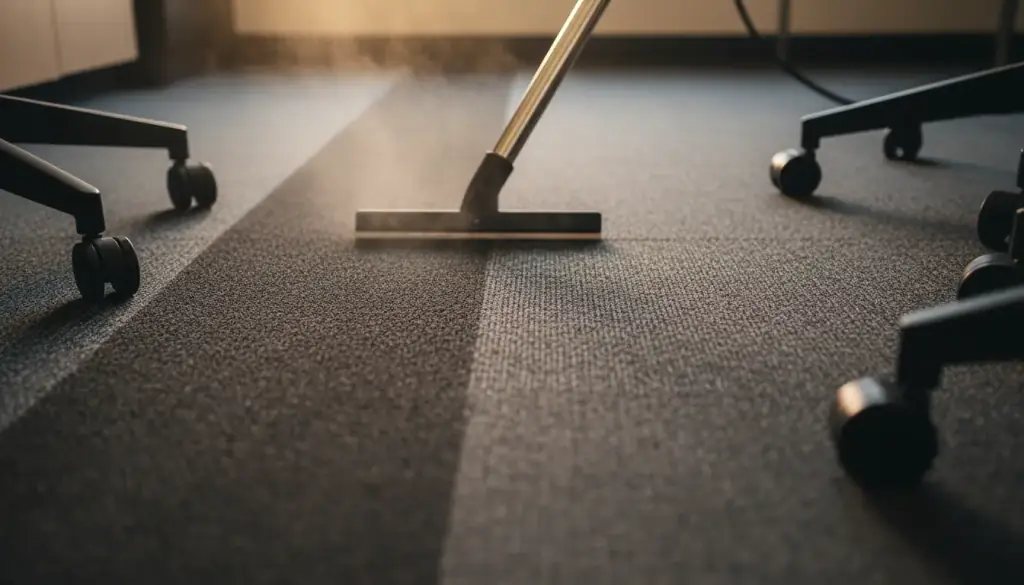
Commercial carpet takes more punishment than any other surface in your building. It collects tracked-in soil, spilled coffee, dust that settles out of the air and the grit that grinds into the fiber with every step. Vacuuming handles the loose layer, but it will not remove the odors and build-up trapped deeper in the pile. Sooner or later every carpeted facility needs a real cleaning method, and two come up in almost every conversation: hot-water extraction and low-moisture encapsulation.
They are not rivals. They do different jobs, and the best carpet programs use both on a rotation. Here is how to tell them apart and how to decide what your building needs.
How hot-water extraction works
Extraction is a deep cleaning process. A technician works a wand across the carpet, driving water and cleaning solution into the fiber to loosen soil, then lifts the dirty solution back out with the machine's vacuum. A good crew pre-treats heavy traffic lanes and spots first, works the solution through the fiber, extracts, and then makes a final pass to pull out as much moisture as possible.
The strength of extraction is that it physically removes soil instead of moving it around. That makes it the right choice for carpets that look dingy, for odor problems, and for the periodic reset every carpet needs no matter how well it has been maintained.
The tradeoff is water. Even with strong extraction, the carpet is damp afterward and needs time to dry. That makes the method a scheduling question as much as a cleaning question.
How low-moisture encapsulation works
Encapsulation, which OctoClean offers as interim maintenance, uses far less liquid. A cleaning compound is applied that bonds to soil and dries into residue that is vacuumed away afterward. Because so little water goes down, the carpet dries faster, and the work can often be done in a shorter window with less disruption to the people using the space.
Its job is to maintain, not to restore. Encapsulation keeps traffic lanes looking clean between deep cleanings and slows the build-up that makes extraction necessary. It is not the tool for a carpet that has been neglected for years or for a heavy stain that has set.
Dry time is the real scheduling constraint
Complete dry time can run anywhere from 8 to 24 hours, depending on the humidity, temperature and airflow in the area. The carpet is walkable immediately after cleaning, although anyone passing through should avoid wet areas when possible. Those are two separate facts, and both are worth planning around.
- A carpet that is walkable can still track. Lay down mats or reroute foot traffic during the first hours.
- Humid weather, a closed HVAC system or poor airflow pushes dry time toward the long end of the range.
- A Friday evening visit gives a building the weekend to dry before staff return on Monday.
- Low-moisture interim work usually fits into a tighter window than a full extraction.
Dry time is also where an overwet job shows itself. If a provider leaves carpet soaking, drying is slower and the odds of a musty smell go up. Ask how the crew controls moisture and how they check that a carpet has dried before they leave the account.
Matching the method to the space
- Lobbies, corridors and reception areas: interim maintenance on a regular rotation, with extraction when the traffic lanes stop responding
- Offices and conference rooms: a lighter rotation because traffic is lower, with extraction when staining or odor appears
- Waiting rooms, classrooms and shared spaces: more frequent attention, because these carpets collect the widest variety of soil
- Spill response: spot treatment first, and extraction of the affected area if the spill has soaked in
How often to schedule each
There is no honest universal answer. Frequency depends on the carpet's condition, its fiber type and its color. The best trigger is the carpet itself: schedule a professional cleaning when traffic areas begin to show soiling. For some facilities that means extraction every six months, and for others once a year or longer. Interim maintenance in between is what stretches those intervals, and it is worth building into the plan from the start.
What to ask a carpet provider
- Who does the work, and how were they trained? OctoClean teaches its technicians in-house, which keeps training and equipment under one standard.
- Will the crew move and return furniture, or are you expected to clear the room? Moving it for you saves your staff the effort and the risk of damaged items.
- Do they build a program around your facility, or sell one-off cleanings? A program tied to your traffic patterns helps extend carpet life and delays the cost of replacement.
- What do they tell you about dry time, and do they plan the schedule around it?
Carpet is expensive to replace, and most premature replacements trace back to cleaning that was too infrequent, too wet or aimed at the wrong problem. A short walkthrough usually settles which method belongs where. Call OctoClean at 951-683-5859 or request a facility walkthrough, and the team can map your carpeted areas to a rotation that matches your traffic and your building's quiet hours.
OctoClean, 951-683-5859
Call 951-683-5859More articles
What a Day Porter Does, and When Your Building Needs One
Nightly janitorial resets a building after hours, and a day porter keeps it presentable while people are actually using it.
Electrostatic Disinfection: What It Covers and What It Does Not Replace
The method is fast and thorough, and it only delivers when it sits on top of a solid daily cleaning routine.